All posts by Mike

How to Live

“Our age is retrospective. It builds the sepulchers of the fathers. It writes biographies, histories, and criticism. The forgoing generations beheld God and nature face to face; we, through their eyes. Why should not we enjoy an original relation to the universe?”

Ralph Waldo Emerson, “Nature”, Selected Essays, New York, 1985, page 35.

Update: Laborious Labored Days

There isn’t a lot of progress to speak of currently. I’ve taken a job teaching a night class on American Literature and this has really put a crunch on time and energy. Although it is material I am interested in, I’m not entirely happy about the fact that it is a time and mind drain. I am hoping that the amount of time, energy and frustration I devote to it wains in the coming weeks. Then I can devote time, energy and frustration to screenplays.

Treatments and screenplays: Last week I got quagmired in one of the treatments. I think I’ve managed to pull myself out of the quagmire now though. I’m not sure how many more treatments I will write before I jump off here at some point into an actual screenplay. We’ll see.

Ameviathan has come to a temporary standstill. I think that of the two screenplays, the *Green Machine* is the more obvious choice to shoot. Now it is just a matter of scouting locations, figuring out what props are needed, seeking out the actors and putting together some sort of hodgepodge crew.

Non-profit and profit research has also come to a standstill. It is a daunting amount reading to do by myself. I’ll get to it, somehow.

So there you have it. Frustration. Part of the process perhaps or perhaps illuminating in terms of decisions that I’ll soon have to make.

Don’t look back.

Update – Mid August 2005

I am currently waiting for Tim to print out some documents on starting a non-profit. Once he does, I’ll review them.

As for writing, I’ve started working on a number of treatments for a potential future feature length film. To date I’ve finished two of these. However, I’d like to write them all out (in treatment form that is) to get an idea of their potentials. The tentative titles are:

  • Space Cops
  • Galaxy Lords
  • Punkies
  • Kill the Poor
  • Never Trust a Dead Guy
  • Night-Mare
  • I Put a Robot Down in NJ
  • Cyber-Rad
  • Bore to the Core

Syd Field and Scriptwriting

When Syd Field writes, “Writing is a personal responsibility; either you do it or you don’t. Do it” (204, Workbook), it is hard to tell who he sounds more like, Yippie activist Jerry Rubin and his “Do It” manifesto or a soapbox-Stan Lee and his Spiderman moral, “With great power, comes great responsibility.” Wherever you position Field on the spectrum ranging from manifesto to downright silver-surfing-cheese, one thing is for certain: when it comes to the how-to’s of scriptwriting, no name shines brighter and more blinding.

What launched Field to the front in how-to’s of scriptwriting was his book Screenplay: The Foundations of Screenwriting, published in 1979. At the time it came out, it was one of the first notable books aimed at the everyman to deal with scriptwriting, and as a result it became somewhat of an institution. Like any institution, it is today loved as much as it is reviled. Certainly timing played into the book’s success, yet it does lay out one tried and true blueprint of screenplay writing – a blueprint that many have acknowledged, albeit grudgingly. Field’s name is so ubiquitous when it comes to screenwriting that today he is name-checked even in the most vacuous of wastelands, such as the June 2005 issue of Maxim. On page 56 snuggled between booze ads and pages of bikini girls glossing tips on golf and car-racing, screenwriter David S. Goyer, credited with the story of the 2005 summer blockbuster, Batman Begins, directed by Christopher Nolan, gives advice to budding screen scenarists. The guidance comes in six bat-bullet points and, excluding the last (some sort of frat-meta-speak about a tough scrotum undoubtedly written in by a Maxim staff writer to placate the target audience), appears to be lifted right out of the pages of Field’s book.

Continue reading Syd Field and Scriptwriting

IRS 501 c3

If there is a film to be shot, then the grit and grime starts here. At Manager DJ Webb’s suggestion, we’re going to go ahead and apply for non-profit status. As he’s pointed out, at the time we decide to switch over to profit, we will.

The process from both what I’ve read previously, and what DJ Webb has told me (Webb has filled out a mess of these over the years), is quite intensive. In DJ Webb’s words, “Remember the Death Star wasn’t built in a day”. I’m currently printing out the government documentation (an application for IRS 501c3 status) that needs to be filled out along with it’s instruction book.

Here was DJ Webb’s timeline for us.

  • August-September 2005 —- Apply for non-profit status
  • August-September 2005 —- Form board of directors, develop bylaws
  • October 2005-February 2006 —- Flush out Script, audition for actors
  • March 2006 —- Awarded 501 c3 Status
  • March 2006 —- Request donations/funding
  • April 2006 —- Begin Filming

The Story of Temple Drake

You think you know everything about something and inevitably you are proved wrong. I just came across this reading Steven C. Earley’s An Introduction to American Movies.

In 1933, Paramount released a film version of William Faulkner’s novel Sanctuary, a story of perversion and corruption. The picture was titled The Story of Temple Drake (1933), and although Paramount pretended to avoid all sexual abnormalities, civic groups were offended because the director had slanted his film to condone a murder. (54)

Now I don’t know if that is true or not, but it is very interesting. I thought the reason why the movie had come under attack was because of the raping of Temple Drake by the gangster Popeye. Earley’s claim, however, suggests otherwise. If Earley is correct, what adds irony to his assertion is that Faulkner’s publisher initially rejected Sanctuary on the grounds that if he published it, it would get them thrown in jail. Later however, Faulkner’s publisher had a change of mind and decided to go ahead and print the novel as it was. However, Faulkner had a change of mind too – and at his own expensive, decided to do an an extensive revision of the book anyway. The main difference between the two versions besides the fact that Faulkner placed more distance between themes and characters he’d explored previously in other novels, was that he added more violence.

Ameviathan Update: A Change in Plans

As of this morning the first rough draft of the second Amieviathan script, The Green Machine, is done. This means that we are one step closer to the second phase of the project, in fact, closer than originally planned.

Life is fluid and there has been a change in plans. On the way to Thom’s the past weekend, Tim and I had a long discussion about this project and potential future projects. At Tim’s suggestion, I’ve decided to scrap the initial plan of writing three separate Amieviathan scripts.

Here’s the rationale. My original intention in writing the three scripts was to get practice more than anything. I knew from the start that the likelihood of getting any more than one of the scripts filmed was highly unlikely. Additionally, the real goal was to prepare for the writing of a feature length movie. The Ameviathan scripts were intended to be short, 20-30 minutes a piece in length. From a filming standpoint, Tim and I wanted to work on a more advanced technical level, and with outside actors. We figured a 20-30 minute movie was enough ambition without biting off the feature length film too. So the Ameviathan scripts were perfectly suited for our filming goals.

However, the three scripts weren’t suited for my writing goal, especially since I’ve achieved what I wanted to in writing-terms with the two short scripts. So at this stage, there isn’t really much point in practicing on another 20-30 minute script. The real practice would come in producing a feature length script.

So we are going to go ahead and begin the initial stages of pre-production as of this weekend. Tomorrow morning, I’ll run Tim a copy of the rough of the script. Then he’s going to read it along with the Boggy Boogieman and we’ll decide which one to develop. The choice of which one to develop is most likely going to be dictated by filming logistics, how many locals we need, how difficult FX will be and how many people we need. The easier of the two will probably be the one that gets shot.

Once we decided which one to develop, I’ll go back and redraft the script and we’ll begin with pre-production.

As for writing, I’ll continue with a new writing goal. Once the Ameviathan script we decide to shoot is redrafted, I’ll start drafting treatments for new feature length script. At this point I’ve got a number of ideas I want to investigate. But, more on them as they develop.
Whirlpool

Last weekend, Tim (Bear), Brian (Dick) and myself went up to DJ Webb’s (Thom’s) house for a party. What a party it was! Of the many people I’ve known, none is a better party host than DJ Webb. His guests’ whims are catered to in every respect imaginable, from choice of beers, to food (which was in this case the Maryland favorite – crabs), to cigars. What’s more, DJ Webb’s house comes equipped with the perfect party-pad layout. On his sun porch, sits an original Contra Arcade game. In the den, there’s an HDTV hooked up to satellite. And who could forget THE POOL.

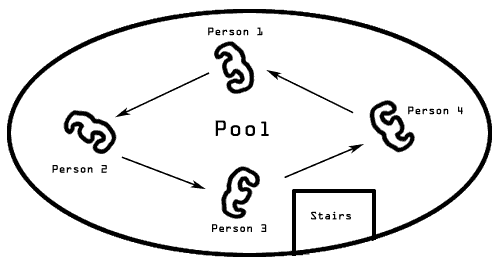
Driving up, Bear explained to me how when practicing with one of the bands he’d played with in high school, he and his band-mates had access to a pool one evening. It was in this pool that he said he and the band made a whirlpool. I’d never heard of anybody making a whirlpool in a swimming pool. I asked Bear to explain. He proceeded to tell me that all you needed were a couple of idiots who would run around the pool in a circle for a while, and presto, you had a whirlpool.

Whirl

When we arrived, along with Dick and Robert, we made a whirlpool. It actually worked and it was awesome. I lay on my back and was sucked round and round staring in inebriated disbelief at glowing tiki-torches and that moronic owl.1

I can’t wait until next year’s party.

1 The owl, made of plastic, sits on the fence surrounding the pool. Thom “claims” to have found the owl in one of the bushes in his yard.